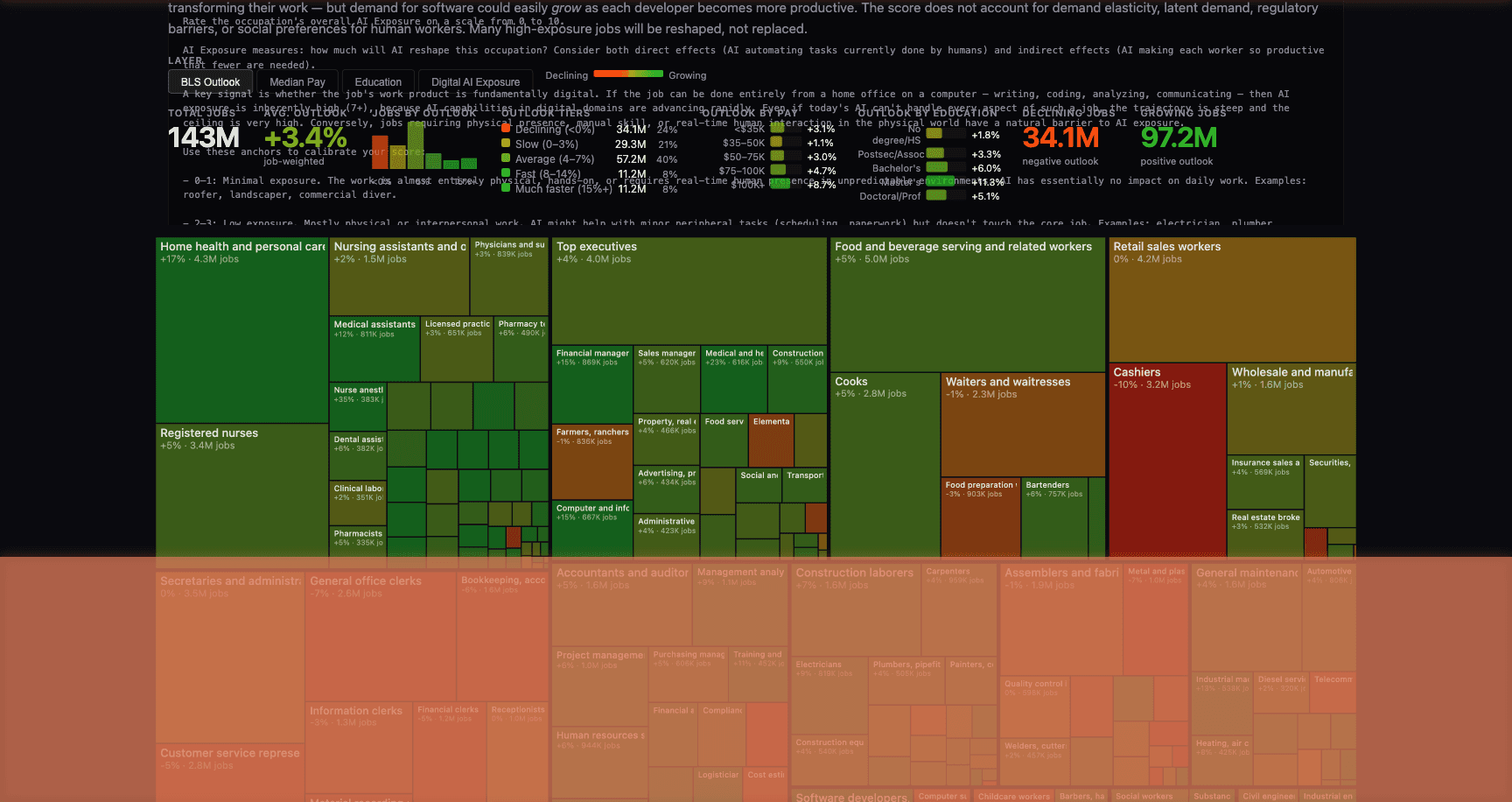
Last week, Andrej Karpathy — OpenAI co-founder, former head of AI at Tesla, and one of the most foundational figures in modern artificial intelligence — published an interactive visualization scoring every U.S. occupation on AI exposure. Using LLM-powered analysis of 342 occupations covering 143 million jobs, Karpathy’s tool maps which roles are most likely to be reshaped by AI. The picture is striking: $3.7 trillion in annual wages sit in jobs scoring 7+ out of 10 on digital AI exposure. Jobs that run on screens, documents, and information synthesis are squarely in the crosshairs.
Karpathy is no armchair commentator. He built Tesla’s Autopilot neural networks. He co-founded the organization that created GPT. When he scores an occupation on AI exposure, it’s informed by having personally built the systems that are doing the disrupting. His analysis isn’t a prediction — it’s an inventory of what’s already underway.
Karpathy’s visualization highlights an interesting pattern: it’s not just the white-collar, screen-based jobs facing disruption. The occupations that coordinate physical work through information systems — dispatching, diagnostics, service management — sit in a unique position. The wrench still turns by hand. But the information that determines what to do with the wrench is exactly the kind of synthesis AI excels at.
Field services is the sleeper disruption nobody’s talking about.
The Fix-Rate Gap Is an Information Problem
Every field service operation runs on a brutal metric: first-time fix rate. When a technician shows up and resolves the issue on the first visit, everyone wins. When they don’t, you’re eating a second truck roll, burning another 2-4 hour service window, and watching customer satisfaction erode.
The gap between your best technicians and your average ones isn’t knowledge in the traditional sense. It’s pattern recognition built from thousands of service calls. Your best tech has seen this symptom before, on this equipment, in this configuration, and knows what it usually means.
When they see a commercial HVAC unit cycling on high-pressure lockout, they don’t start with the troubleshooting flowchart. They check the condenser coil first — because they remember that the same customer’s units, installed by the same contractor three years ago, had undersized condenser coils that only cause problems above 95°F. That’s not in any manual. It’s in their memory of the service history.
Your average technician follows the flowchart. Two hours later: “need to order parts.” The fix-rate gap isn’t a training problem. It’s an information access problem.
What Changes With 1M Context
Anthropic’s 1M token context window — now at standard pricing for Claude Opus 4.6 and Sonnet 4.6 — holds roughly 3,000 pages. That’s years of service history, equipment manuals, parts catalogs, and diagnostic records for an entire fleet in one pass.
Pre-dispatch intelligence. Before the technician leaves the shop, load the complete service history for the customer’s equipment — every work order, every parts replacement, every note from every previous visit — alongside the equipment manual and known-issues database. The AI generates a diagnostic briefing: most likely root cause, parts needed, site-specific access considerations. Every technician arrives with the pattern recognition your best tech has.
Cross-fleet pattern recognition. A recurring issue on one unit might be a fluke. The same issue across 50 units of the same model, in similar environments, is systemic. Load complete service history across the fleet and ask: “Which failure modes correlate with specific installation configurations or maintenance intervals?” The model finds patterns your best regional manager knows intuitively but has never been able to document.
Knowledge capture from retiring expertise. Manufacturing and field services face the same generational problem: the technicians who can diagnose by sound are retiring. Load their complete service history — every work order, every note, every escalation — alongside cases where average technicians struggled with the same equipment. The model identifies the diagnostic shortcuts that distinguish expert troubleshooting from flowchart-following.
Parts prediction. First-time fix rate is often a parts availability problem. Load complete parts consumption history by territory and optimize truck stock by technician, season, and equipment mix. The model identifies that techs serving commercial kitchen accounts in summer need specific compressor contactors that aren’t in the standard stock but account for 30% of repeat visits.
Why This Is the Sleeper Disruption
Karpathy’s exposure scores focus on digital work — jobs where AI can directly perform or augment the core task. Field services scores lower because the physical work can’t be automated. But the information layer that determines the quality of that physical work is entirely automatable.
The gap between a 90% first-time fix rate and a 40% rate isn’t skill with a wrench. It’s access to the right diagnostic context. That’s exactly what a model with full service history in context provides.
For a field service operation running 1,000 calls per month at a 55% fix rate, improving to 70% eliminates 150 repeat visits per month. At $200 per avoided truck roll, that’s $30,000 in monthly direct savings. The AI analysis costs pennies per call. The ROI isn’t theoretical — it’s arithmetic.
The industry facing the biggest skilled-labor shortage is also the one where AI can most directly close the expertise gap. That’s not a coincidence. It’s an opportunity.
We build AI platforms for field service operations — dispatch optimization, diagnostic intelligence, knowledge capture — for organizations where the gap between best and average performance is measured in truck rolls and customer churn. If you’re evaluating what this means for your service operations, start a conversation.